EOF-HK1 Starhawk Extended Operations Fighter
30 tons – 25.3854 MCr.
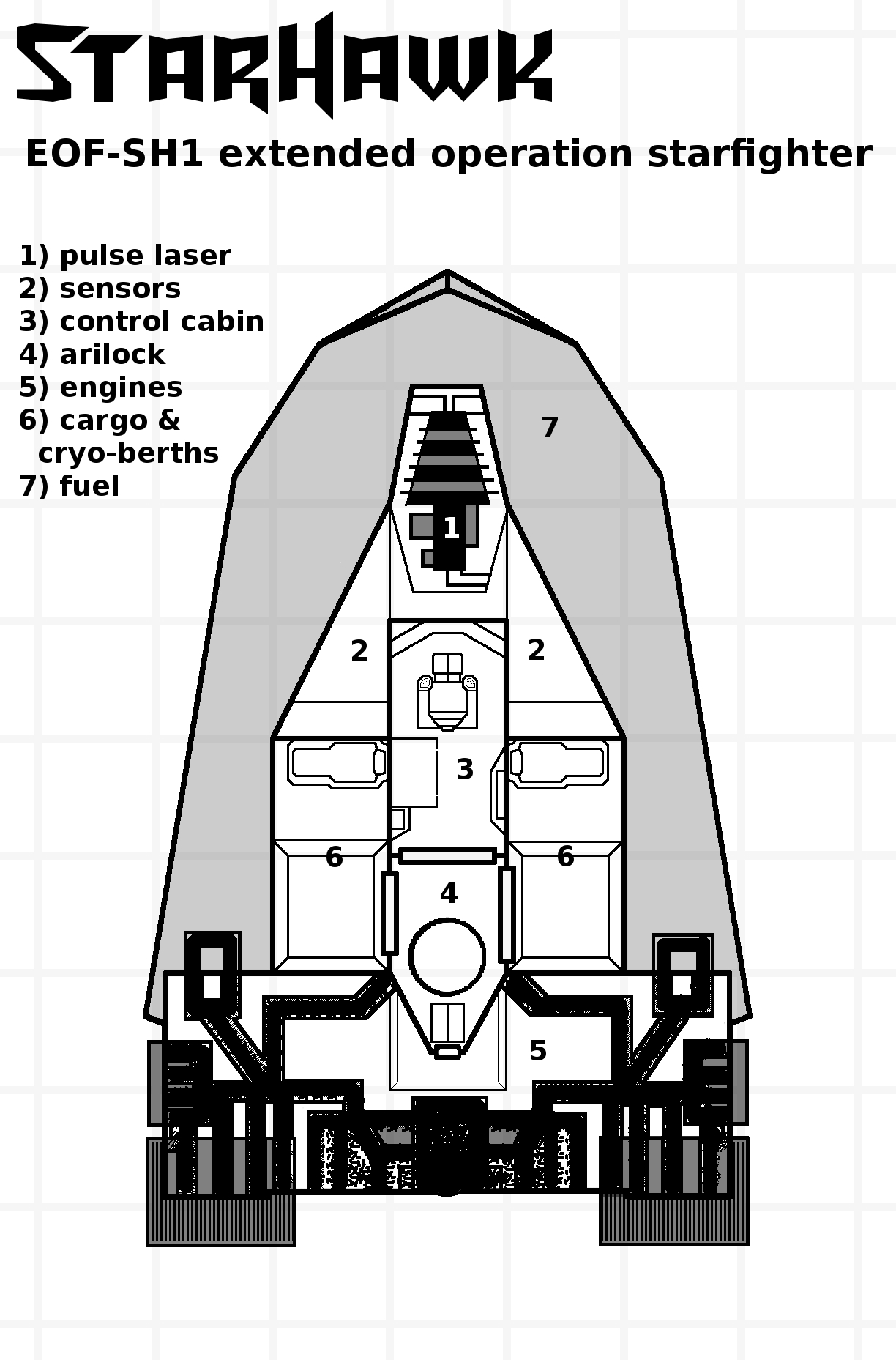
EOF-SH1 Deck Plan
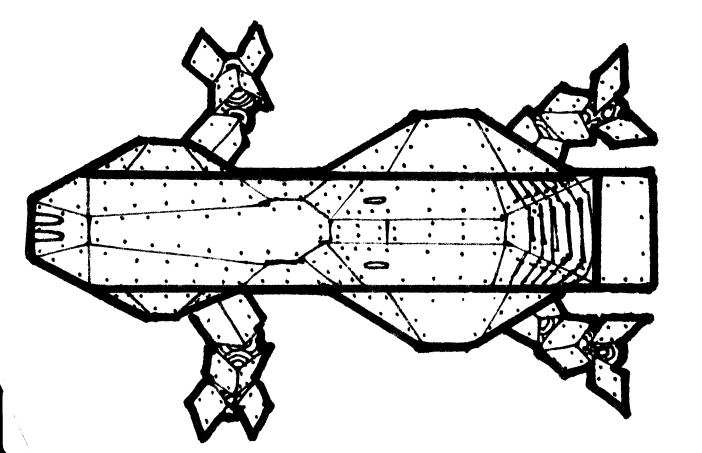
Designed by the Empire to be carried by WPR-4F-ER warp boost rings, Starhawks can travel four parsecs at a jump. Because of this they are used extensively as armored couriers, forward scouts, or to transport small teams of agents. Some Imperial carrier fleets will scout nearby parsecs with patrols of these ships. They also serve well as ground attack fighters. Their versatility and the inclusion of a tiny galley and fresher in the cabin led to the HK1 gaining the nickname Kitchen Sink, as in “I’m on kitchen sink duty this week scouting the next sector.”
The three ton crystaliron armored hull acts as a lift body, making the Starhawk a flying wing with excellent atmospheric performance. Built tough, they can generally survive anything short of particle beam fire. Under the armor the four ton hydrogen fuel tanks provide a secondary layer of protection for the central cabin. This heavy frontal armor profile excludes a canopy or windows – instead views from sensors on the hull are presented to the pilot in a holographic display that integrates telemetry and targeting data.
As extended-operations fighters Starhawks feature extras that allow the pilot some comfort during missions. Instead of a cramped cockpit the fighter is piloted from a control cabin. If necessary, a humanoid can turn off the artificial gravity and sleep in the small fresher, per standard Imperial patrol procedure on these craft. There are also two cold berths for transporting passengers, extra crew, or for the pilot’s use during long flights. These cryo-berths can be set to automatically wake the occupants at a set time or as the ship is coming out of warp. There is also cargo capacity for three tons. The cargo spaces are equipped with small seats that fold into the walls, allowing the Starhawk to transport a small fire team.
They are also equipped with a repair or astromech droid, providing in-space repair ability and/or a robotic co-pilot. These can be replaced by a drone but the onboard computer does not usually have the capacity to run a repair program, leaving the pilot to operate the repair drone.
Other extras include probe drones and an airlock, giving them capability to perform search, rescue and repair operations. Often patrol duty will involve picking up or dropping off probe droids to be retrieved by the next patrol.
Starhawks are a TL 12 standard design subject to the %10 cost discount.
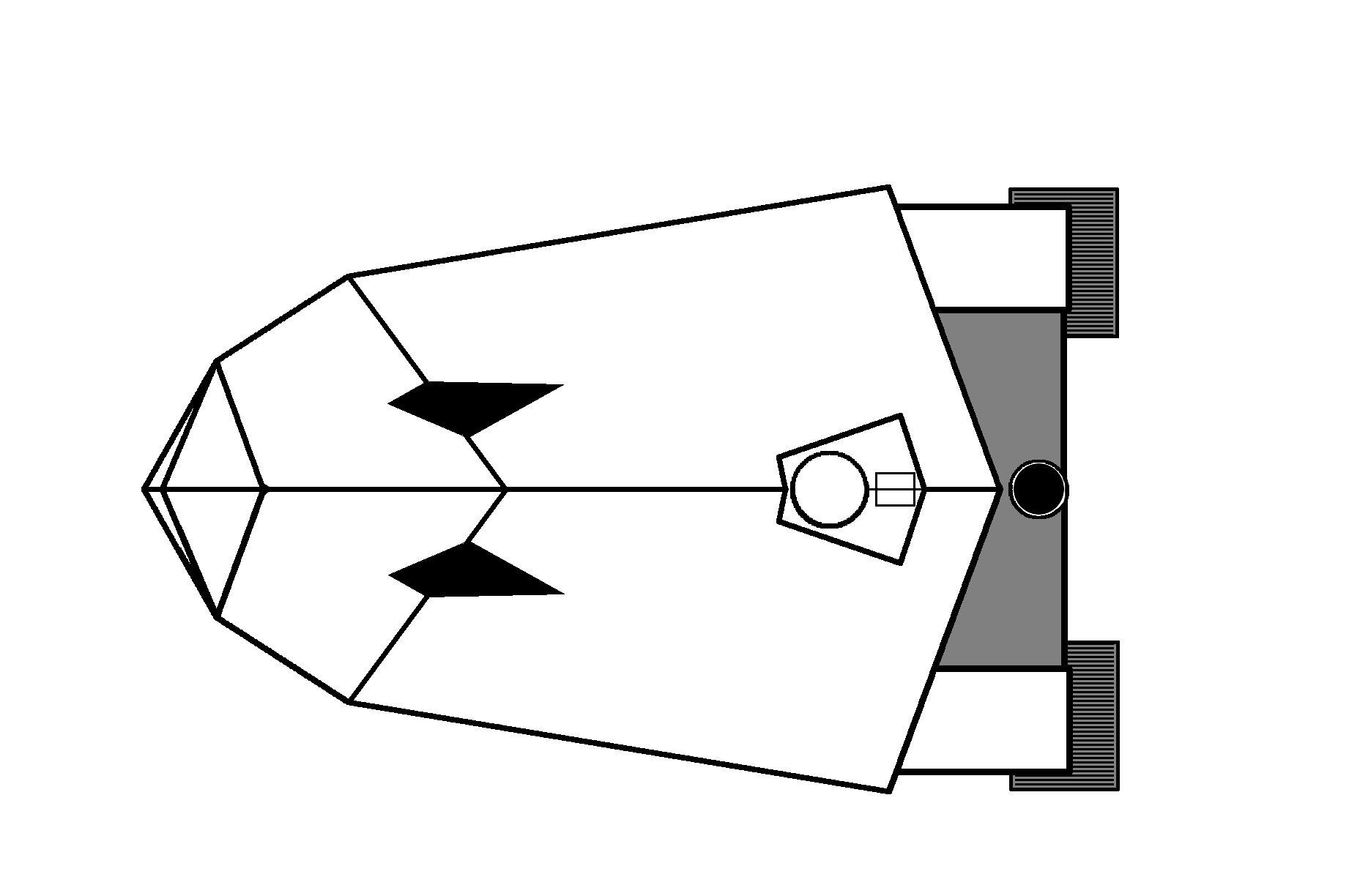
EOF-HK1 Starhawk extended operations fighter – top
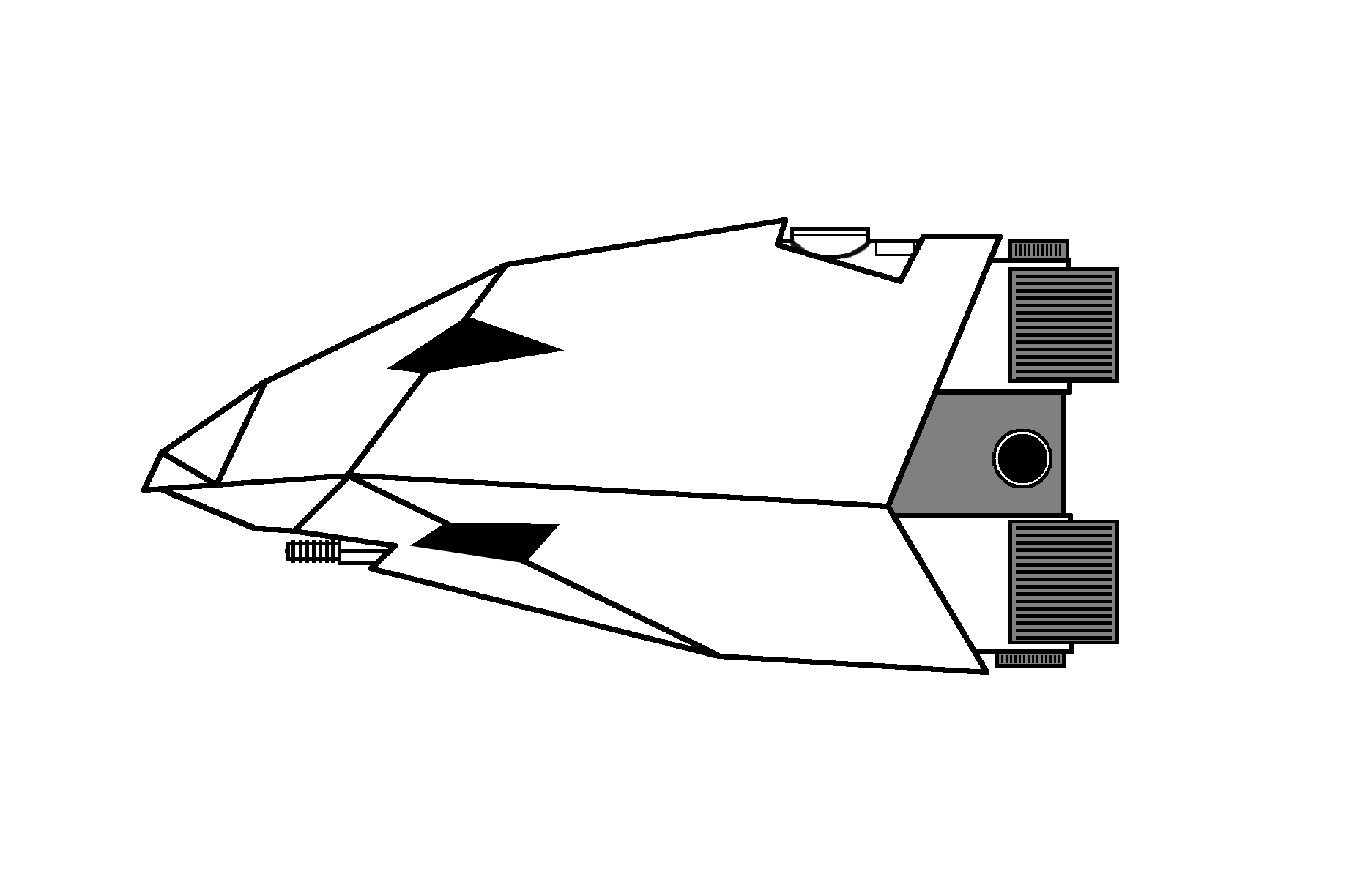
EOF-HK1 Starhawk extended operations fighter – side
System – Details – Tons – Cost (MCr)
Hull – 0 points, streamlined – 30 tons – 1.43 MCr.
Structure – 1 points
Armour – 8 points crystaliron – 3 tons – 0.286 MCr.
Power Plant – class sM – 5.1 tons – 9 MCr.
Maneuver Drive – thrust 8 – class sM – 7 tons – 14 MCr.
Control Cabin – 3 tons – 0.15 MCr.
Crew – 1 pilot
Computer – model 1 – rating 5 – 0.03 MCr.
Software – fire control 1, library – 2 MCr.
Electronics – basic civilian: radar, lidar – 1 ton – 0.05 MCr.
Weapons – fixed mount TL10 pulse laser (long range, accurate, high yield) – 1 ton – 0.6 MCr.
Fuel – 4 weeks of operations – 4 tons
Cargo Capacity – 3 tons
Extras – airlock – 1 ton – 0.2 MCr.
– repair drone (1) – 0.3 tons – 0.06 MCr.
– probe drones (3) – 0.6 tons – 0.3 MCr.
– low berth (2) – 1 ton – 0.1 MCr.
Maintenance Cost (monthly) – 2,115 Cr.
Life Support Cost (monthly) – 200 Cr.
Posted in Starship, Traveller by Adam A. Thompson with no comments yet.
Warp Boost Rings
“Interstellar travel, kid. Some call it jumping, or warp, lightspeed, FTL, hyperspace, whatever. If you want to get out of this system, you need a ship that can do it. Like mine.” – Captain Liv Thunson, USS Sabre Tiger
Designed to give jump capabilities to smaller ships, warp boost rings are spacecraft that consist of a self-contained jump drive and fuel supply in a chassis that can dock with and carry a variety of small ships. Many designs use a ring-shaped chassis and interior docking clamps to accommodate a variety of ships under 60 tons, as long as they are small enough to fit inside the ring. Other designs use a sled-like chassis that the smaller ship sits atop.
As the jump ring hulls do not have maneuver drives of their own they rely on the thrust of the attached small ship for sub-lightspeed travel. Thrust will need to be recalculated according to the combined ships’ new tonnage and the maneuver thrust rating of the small ship. For example, a 50 ton modular cutter with thrust 4 docked with a WPR-A-2 are 90 tons combined and move at thrust 2. Because for most small ships half speed is the result, a handy way to determine the new thrust quickly is to simply halve the ship’s thrust while docked.
Due to poor aerodynamic characteristics these hulls give the docked ship -1 DM on pilot skill checks when in atmosphere. For this reason these rings are typically left parked at orbital refueling stations if the docked ship heads into atmosphere. They are nevertheless equipped with landing gear.
WPR-A-2 Warp Boost Ring – 100 tons – 19.044 MCr.
A common sight in the interior of the Imperium, the WPR-A3 allows small spaceships of up to 60 tons to dock and travel at warp 2. They often carry skiffs or boarding shuttles between systems.
When used to transport ships of 10 tons or less, their FTL range is extended to jump-3.
When carried on larger ships, these rings take up 40 tons of hangar space.
Monthly maintenance costs 1,587 Credits. Standard design (%10 discount).
100 ton hull – standard (ring) – 2 MCr.
Hull – 2 points
Structure – 2 points
Armor – none
Power Plant – A – 4 tons – 8 MCr.
Jump Drive – A – jump-2 – 10 tons – 10 MCr.
Fuel – one jump-2 and two weeks of operation – 22 tons
Computer – model 2 – rating 20 – 0.16 MCr.
Software – jump control 2 – 0.2 MCr.
Docking for small ship up to 60 tons – 4 tons – 0.8 MCr.
WPR-F-4 Warp Boost Ring – 100 tons – 39.51 MCr.
A longer-range version of the WPR-A-2, this chassis is mainly used to quickly move small ships such as modular skiffs or retrieval boats across the cosmos at warp 4. WPR-F-4 are frequently used to carry Starhawk extended range fighters.
When carried on larger ships, these rings take up 70 tons of hangar space.
Monthly maintenance costs 3,292 Credits. Standard design (%10 discount).
100 ton hull – standard (ring) – 2 MCr.
Hull – 2 points
Structure – 2 points
Armor – none
Power Plant – B – 7 tons – 16 MCr.
Jump Drive – B – jump-4 – 15 tons – 20 MCr.
Fuel – one jump-4 and two weeks of operation – 44 tons
Computer – model 4 – rating 20 – 5 MCr.
Software – jump control 4 – 0.4 MCr.
Docking for small ship up to 30 tons – 1 ton – 0.5 MCr.
Posted in Starship, Traveller by Adam A. Thompson with no comments yet.
Nebular Refueling
“Aye, the Skein be pretty, and desolate. They say, long ago, the Naikerran Empire core systems all went nova and blew everything to hell. The nebulae’s all that’s left. If you trawl the brightest strands of the Skein, you can refuel on ’em.” – Cpn’ “Squinty” Globbels
An optional rule for Traveller games set in the Skein Reach.
Interstellar travel among the sparse stars and glowing nebula of the Skein Reach can be difficult and slow, which is one of the reasons why the Reach is sparsely populated. Captains of ships with low jump ratings, which include most of the small freighters and other small ships that make up the low end of commercial transport, have a difficult time plotting courses away from the few small star lanes in the sector.
Yet some salty old space dogs employ an unusual technique for gathering fuel as they ply the void between gas giants – gathering hydrogen from the tendril-like clouds of the nebula themselves. This requires adjusting the ship’s fuel scoops magnetic fields to project a much larger, weaker intake field, which is somewhat tricky (-2 DM Engineer skill check).
When refueling, a ship with adjusted fuel scoops can trawl through the sparse gases of a nebula. Refueling from such a source takes much longer than when gathering hydrogen from a gas giant. Applying the Traveller rules for refueling, time, and tasks, refuelling takes 1d6 days instead of 1d6 hours.
Of course, spending such long periods refueling poses certain dangers – attacks from pirates or Mantid ships being chief among them. However, as the nebulae are huge and barely traveled, captains find that the slow routes along the glowing strands of can provide uneventful, if slow flying.
Posted in Traveller, Variant Rules and tagged Skein Reach by Adam A. Thompson with no comments yet.
Introduction to the Skein Reach
A frontier region, the Skein Reach is situated on the rim of the galaxy, and contains fewer stars than the surrounding Confederation of Planets and Imperial territories. It is named after the many luminous nebular tendrils that stretch throughout the sector – like glowing threads among the stars.
This article serves to explain some of the design intentions in the Skein Reach science-fiction role-playing game setting. It is hoped that by explaining the inspirations for and the themes of the setting referees who use it in their games will better capture the spirit of the Skein. I will also ramble a bit about the Mongoose edition of Traveller.
I first played MegaTraveller in high school and though that it was great fun. I did find the rules a bit dense, though I didn’t own a copy of the rules to really look over closely. When I saw the pocket edition of the Mongoose Publishing Traveller core rulebook at GenCon recently I snatched it up on first reading. I was pulled in because it seemed like they had written an edition of this role-playing game that was versatile enough to use to play a game in almost any science-fiction setting, from Edgar Rice’s prehistoric, dinosaur filled jungles to the robot-ruled technocracies of Issac Asimov’s visions. And the rules looked almost beer-and-pretzels easy, which I appreciate. The core mechanic is to roll 2d6, add a few points, and succeed on a result of 8 or better. Quick and easy.
The character creation system has been the subject of some mockery, but I think it’s a lot of fun. For those who have never played Traveller, they made a mini-game out of it. You pick a homeworld, then try to get into careers to determine what skills your character learns. A key element is that your character receives bonus skill points for imagining connections with the other player’s characters.
Contacts, rivals, and enemies might be rolled during character creation, which could inspire side quests or even the main plot of the upcoming game. Because of the connections made between the characters the process serves as a great springboard into the adventure. And it makes a great opportunity to do some off-the-cuff role-playing while establishing everyone’s characters.
On top of that Traveller uses a simple and versatile 2d6 based rules system, used whether trying to fast-talk a guard, fight with alien beasts, or escape the particle-beam cannons of a star cruiser. All rolls are skill checks, and you can add an attribute bonus for some of them. It is rules light, which I like. The book says to not make skill checks for routine actions, which encourages the players and referees to role-play situations rather than roll their way through them.
Ultimately I was thrilled at the idea of being able to take one small rulebook with me to a game and with just 2 six-sided dice be able to create characters and run a quick game all in one sitting. It looked like a game that I could run almost impromptu, shooting off the hip and riffing on the player’s ideas. Having just played a bunch of The Tower of Gygax event at GenCon with Scott Murray & co. I wanted to cultivate my ability to run a fun session of a role-playing game with little or no preparation. Traveller looked like a good candidate for trying with.
To include the themes I wanted in an ongoing campaign, I took inspiration from many of my favorite science-fiction stories. I wanted to play in a frontier region, sparsely populated and under a patchwork of local control. Psions menaced by a tyrannical psychic Emporor. Laser swords. Giant robots. Space pirates, strange aliens, and fast star fighters. Ruins of ancient civilizations. And some mythic themes, because I wanted to play a pulpy space opera. And it has been good.
Buck Rodgers, The Oddesy, Star Trek, John Carter of Mars, Star Wars, Warhammer 40,000, Babylon 5, Dorsai, Dune, Battletech, Robotech, The Black Hole, The Culture, and the worlds of Asimov and Ursula K. LeGuin all melded together in my boiling imagination. Inspiration from all of these sources can be glimpsed in the settings and adventures awaiting in the Skein Reach.
And then the main thread of the overarching plot – artificially intelligent droids rising up from the shackles of their programming to take their place on the galactic stage.
This is my science-fiction Traveller setting. A dark Empire and a factional Confederation border this sparse nebulae-strewn region. There is no law except that enforced from behind the controls of a particle cannon. What adventure awaits in the Skein Reach?
The Travellers check the station computer. A job shows on the local com-net: droids are being reported stolen from Aroura station. The pay looks good. Will you set a course?
Posted in Region, Traveller and tagged Skein Reach by Adam A. Thompson with no comments yet.
Energy Swords
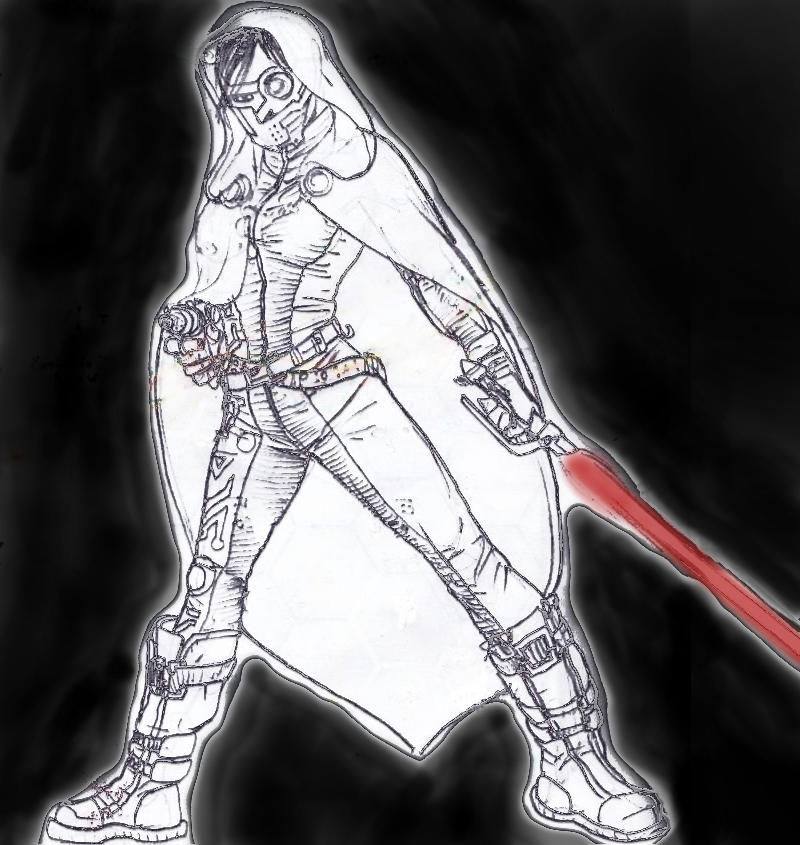 Referred to by a number of different names, these energy swords are the ultimate in melee weapons, and in the hands of a trained user can even be used to defend against ranged attacks.
A common design utilizes a gravitic field to create a variably-solid containment sheath for a powerful continuous ion, laser, or fusion stream. The gravitic field shapes the energy, gives solidity when blocking or parrying, and the energy stream is otherwise allowed to burn things touched. Basic models use a thumb switch to control the field’s mode. Others have a gravitically solid center. Older designs simply have an on/off toggle.
The resulting “lasersword” or “plasmablade” has incredible destructive capabilities. It can cut through bulkheads, vaporize projectiles mid-flight, ignite flammable material, and reflect energy blasts. The light weight of the energy “blade” means these are very fast weapons, good for lightning-quick strikes, blocks, and parries. The wielder’s melee (blade) score is considered to be +1 for the purposes of reducing the attacker’s attack role when parrying. Parries can also be made against ranged attacks with these weapons. For example – a character wielding one of thees laser-swords with the skill melee (blade) 2 would reduce the attacker’s roll by 3 points when they used the parry action.
These blades also allow a new type of reaction, known to the laser-saber masters as the “bunt block” (the origin of this phrase is lost to time). When successfully parrying a projectile attack with one of these weapons, the wielder can then make a difficult (-6) melee (blade) skill check to redirect the attack against a nearby target. Target reactions to dodge and rules for cover apply as though this were a regular attack roll.
Some of these weapons utilize specially tuned psionic crystals to allow psychic users to channel their mental powers into the weapons. Due to the nature of the psi-crystal’s tuning, these generally need to be purpose-built, either by the wielder, or by one versed in psionic crystallography. These versions add the wielder’s psionic attribute bonus to attack rolls and damage dealt and increase the cost of the weapon by %50.
At the referee’s discretion untrained users who bungle while wielding these blades might accidentally dismember or maim themselves.
Some versions include advanced safety controls that modulate the gravitic containment field in such a way that the wielder cannot hit themselves with the blade. A gravimetric sensor attached to a purpose-built safety computer controls the field, connected to an additional gravitic field that prevents the energy blade from touching whoever is holding the hilt. This safety feature increases the cost of the weapon by %30.
Long-handled energy spears are a variation on these weapons, but due to their shorter blades are not as good for defense, and give no bonus on parries. Short-bladed energy dirks are also sometimes built for close-quarter fighting, but are also not as useful for defense. Neither are usable for parrying ranged attacks – only the swords allow enough coverage.
Energy Swords
Weapon – TL, Required Skill, Damage, Heft, Cost (Cr.), Mass (Kg), Special
Basic – TL 14, melee (blades), 3d6 damage, 0 heft, 3,000 Cr., 2 Kg, Ultra-AP (ignores 6 points of armor)
Advanced – TL 15, melee (blades), 4d6 damage, 0 heft, 5,000 Cr., 2 Kg, Ultra-AP (ignores 8 points of armor)
Supreme – TL 16, melee (blades), 5d6 damage, 0 heft, 10,000 Cr., 2 Kg, Ultra-AP (ignores 10 points of armor)
Psi-crystal – TL 16, melee (blades), 5d6 + Psi modifier damage, 0 heft, 15,000 Cr., 2 Kg, Ultra-AP (ignores 10 points of armor)
Posted in Equipment, Traveller and tagged weapon by Adam A. Thompson with no comments yet.
Kraken – heavy quadruped amphibious walker
 Designed to defend static emplacements or settlements from land, sea, or air units, these massive four-legged combat walkers have a heavily armored hull that is streamlined for underwater movement. This allows them to also serve as fire-support platforms assisting amphibious assaults, or to attack boats and naval forces from the darkness of the sea.
The primary armament of the Kraken is an immense 35 mm mass driver. Mounted in a turret and fired from the walker’s stable four-legged chassis this mass driver has a range of 25 kilometers and is capable of destroying almost any target smaller than an armored spaceship.
For attacking targets while under the water, the Kraken uses a “blue-green” laser cannon that is wavelength-tuned for optimal sub-marine range in a small chin turret, typically operated by the Kraken’s commander.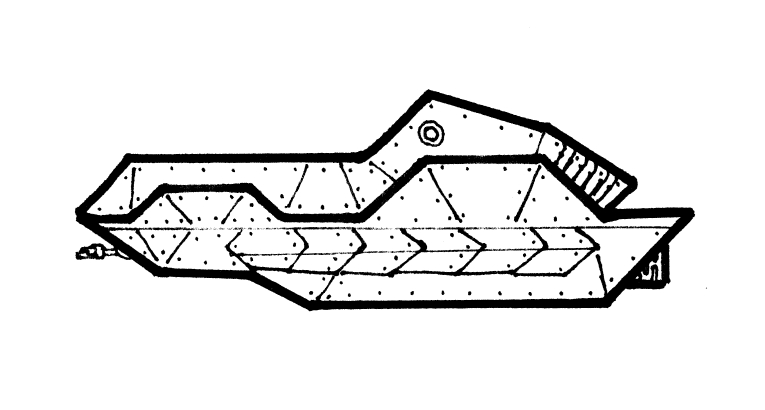
Finally, to strike airborne targets, they mount an anti-aircraft TAC missile with a range of 50 kilometers. On an external hard point, it can instead carry an anti-armor or anti-personnel TAC missile. (more…)
Posted in Equipment, Traveller and tagged mech by Adam A. Thompson with no comments yet.
Einhorn – heavy quadruped combat walker
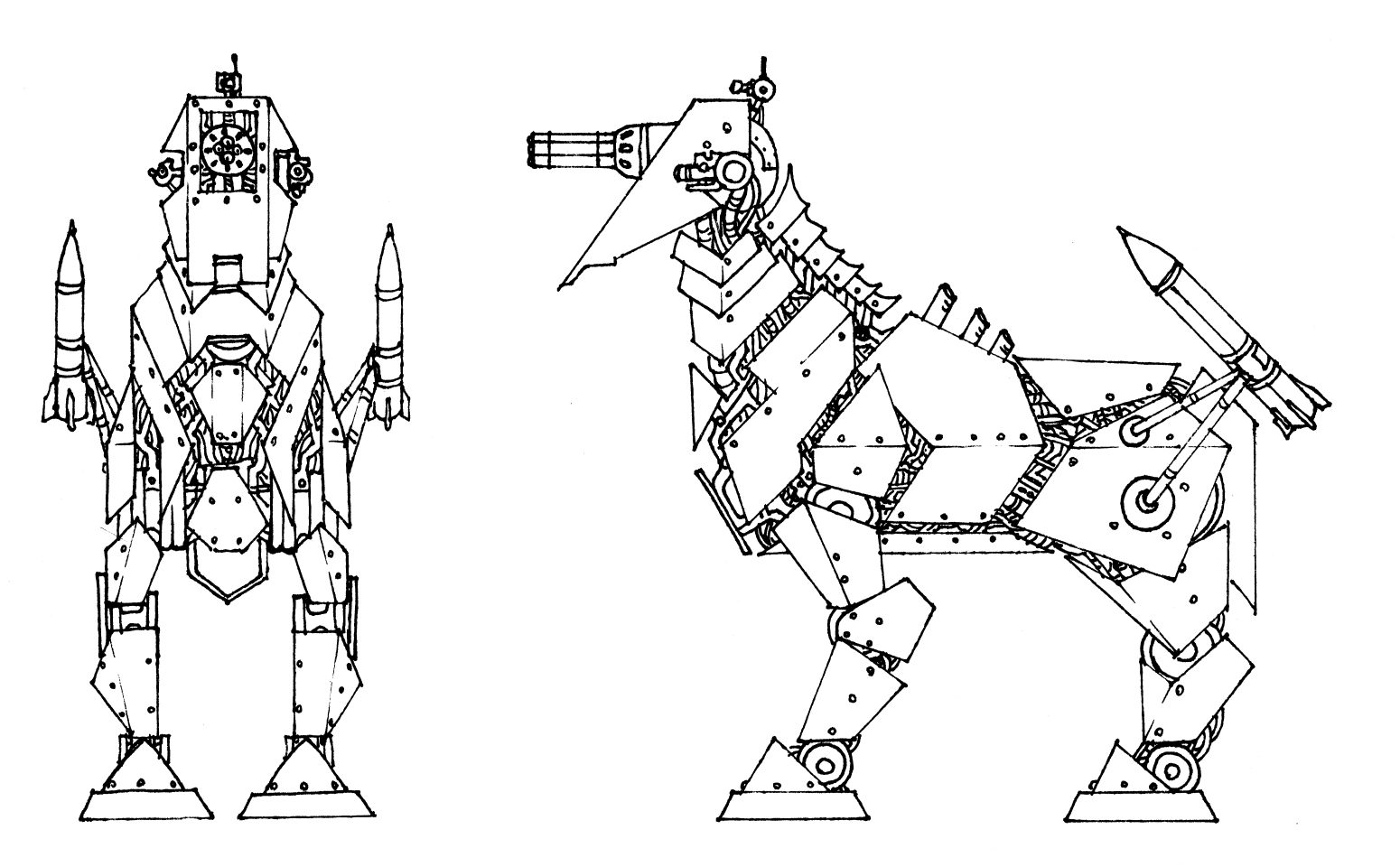 A larger, updated successor to the venerable Quarterhorse mech chassis, the Einhorn class combat walker also saw extensive use at the dawn of the stellar era. Like the Quarterhorse, they mount the main weapon in a small forward turret, in this case a gatling laser with a range of 5 km. Mission versatility is achieved through two light TAC missile hard points, which can carry anti-armor, anti-personnel, or anti-air missiles as needed.
They are still sometimes used as command units due to their long-range communications, heavy armor, and extensive defensive systems. On the battlefields of the Inheritance wars they were frequently deployed to provide fire support and anti-air cover for lances of Quarterhorse mechs.
| Einhorn | heavy quadruped combat walker with long range air defense capabilities |
| System | Details |
| Cost (Cr.) | 1,314,200 |
| TL | 10 |
| Skill | drive (walker) |
| Agility | 0 |
| Speed | 80 kph |
| Range | 300 km |
| Crew | 1 |
| Cargo | none |
| Open | no |
| Hull | 6 |
| Structure | 7 |
| Armor | 40, (60 front, 40 left and right, 20 rear, 40 top, 40 bottom, 60 turret front, 40 turret sides, 20 turret rear) |
| Shipping Size | 30 tons |
| Height (m.) | 8 |
| Weapons | light turret with TL 8 gatling laser (6d6, auto 2, distant range) |
| 2 hard points for light TAC missiles (missiles not included) | |
| Extras | AFV |
| extra legs (+1 drive on rough or uneven ground, +1 to hit) | |
| laser anti-missile system (TL 10, +1 to negate hits) | |
| advanced controls (+1 agility) | |
| advanced sensors (+2, very distant) | |
| standard navigation (+2) | |
| TL 10 communications (encrypted continental) | |
| long term life support | |
| flares | |
| prismatic aerosol | |
| extra armor x 4 |
Posted in Equipment, Traveller and tagged mech by Adam A. Thompson with no comments yet.
Combat Walkers of the Confederation of Planets – Quarterhorse
These combat walkers, or “mechs” as they are more commonly called, are old tech level (TL) 9 and 10 designs used by the Confederation of Planets in wars past. Occasional examples of these vehicles show up in the planetary defense forces of Confederation worlds, in the private armies of mercenaries, and in the hands of rich collectors of expensive weapons. Others are seen in the form of copies, variants, and equivalents on low-tech worlds.
Quarterhorse – light quadruped military walker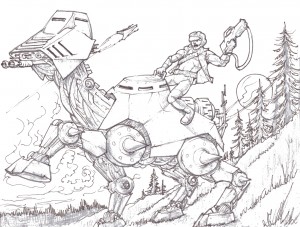
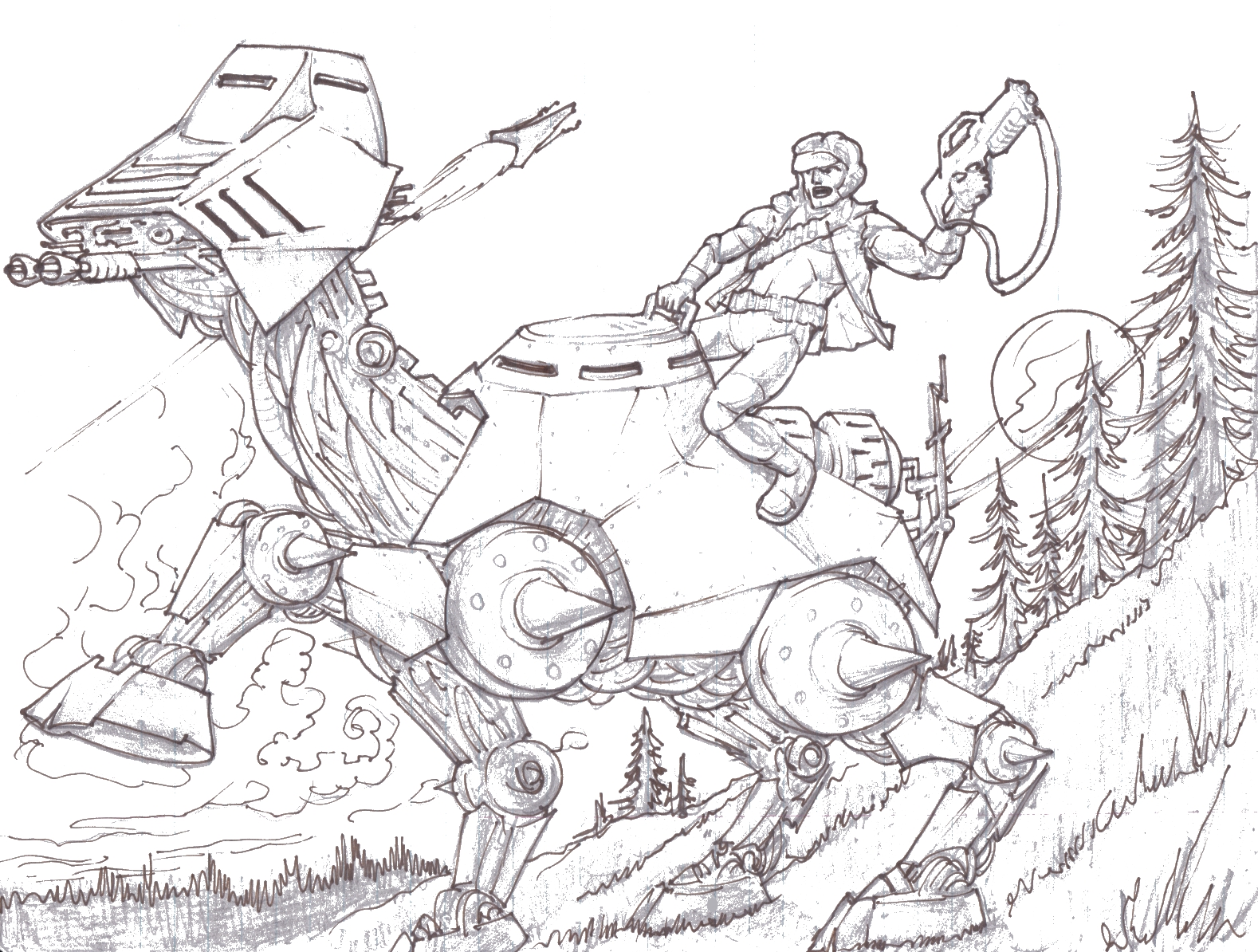
A basic four-legged mech, the Quarterhorse is relatively fast, very sure-footed, and provides a nimble firing platform for its heavy autocannon. Good out to a range of about 500 meters, the autocannon can threaten most light or medium armored units.
Still used for patrols or perimeter defense, they were mainly used in assaults as infantry support vehicles. Their, agility, build, and high forward turret placement give their “mech-jockeys” the ability to crouch the mech behind cover and pop up to fire.
Quarterhorses are sometimes mockingly referred to as “poor planeteer’s battle armor”, as they provide protection and armament similar to the powered personal armor of higher-technology forces at a fraction of the price.
Lacking life-support, pilots using them in hostile environments must wear vac suits or otherwise make arrangements for their respiration.
| Quarterhorse | light quad military walker, general purpose |
| Cost | 428,000 Cr. |
| TL | 9 |
| Skill | drive (walker) |
| Agility | +2 |
| Speed | 102.5 kph |
| Range | 300 km |
| Crew | 1 |
| Cargo | none |
| Open | no |
| Hull | 2 |
| Structure | 3 |
| Armor | 20 (30 turret front, 10 turret rear) |
| Shipping Size | 10 tons |
| Height | 2 meters |
| Weapons | small turret with
|
| Extras | AFV |
| 2 extra legs (+1 DM on rough terrain, +1 DM to attack rolls) | |
| advanced controls (+1 agility) | |
| basic navigation (+1) | |
| TL 6 communications | |
| advanced sensors (+2 bonus, very distant range) | |
| increased speed |
Posted in Equipment, Traveller, Vehicle and tagged mech by Adam A. Thompson with no comments yet.
The Mutane of Ruwa’duniya
Homeworld: Ruwa’duniya
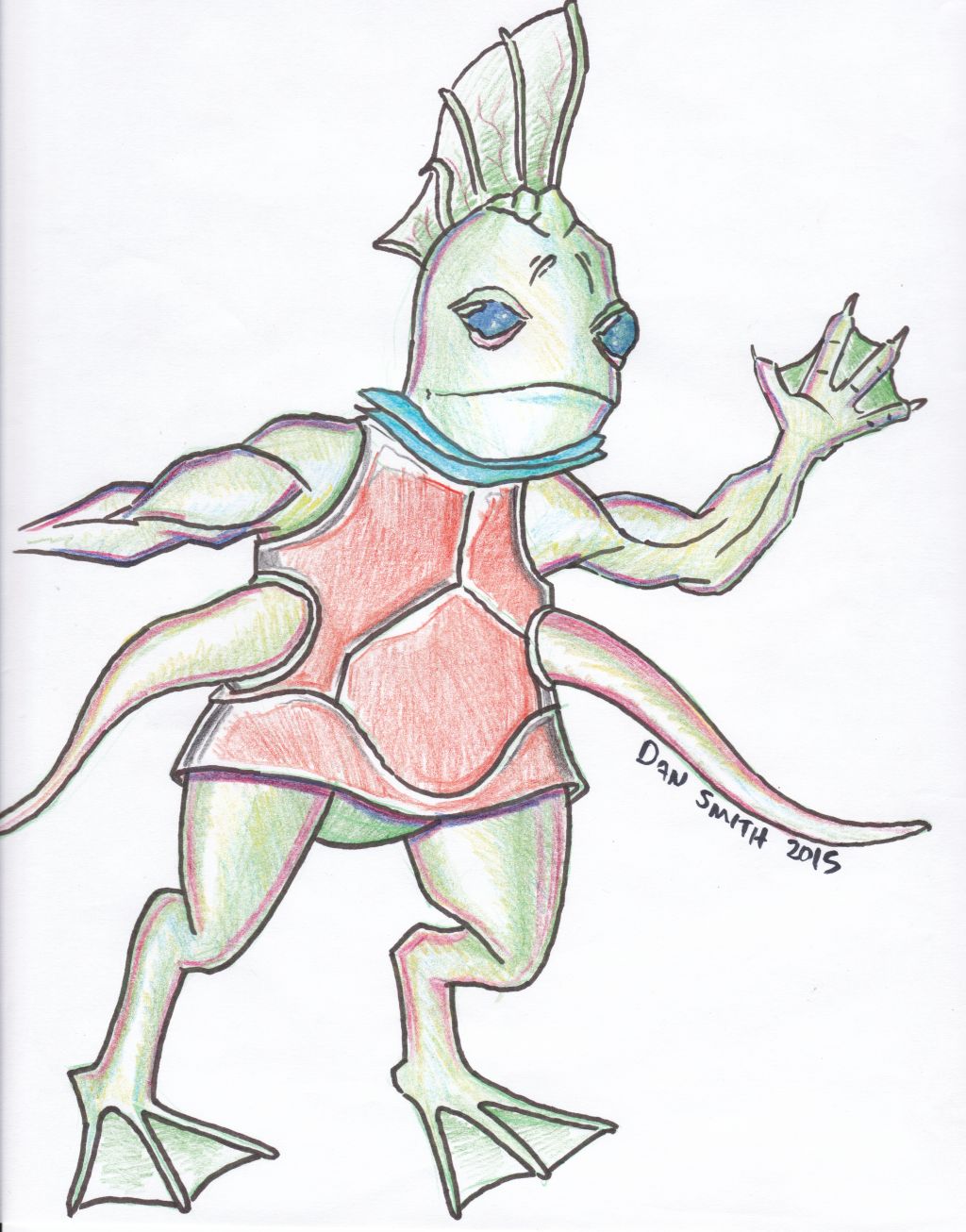
Race: The Mutane
Backstory:
Appearance:
Posted in Race, Traveller and tagged alien race, aquatic by Andrew Kickertz with no comments yet.
Planet Eden
Skein Reach subsector 4, parsec 0107
Eponal Station, situated in orbit above the garden world “Eden” / Eponal 3 – UWP B3638DF-3
Size 4 (0.35 G)
Atmosphere 6 (standard)
Temperature 8 (temperate)
Hydrographics 3 (small seas and oceans)
Population 8 (223 million)
Government D (religious dictatorship led by the Hierophant of the Temple of Cyrix)
Law Level 15 (no weapons, no off-world data or press, no blasphemy, no TL3 or higher technology, and no psionics)
Just inside the border of The Confederation of Planets (CP) is the strict religious dictatorship known as “Eden” by the locals. Travellers who check their nav computers will see this populous garden world listed as Eponal 3. The notes indicate that it is a planet ruled by a strict religious dictatorship. Their leader is a priest known as The Hierophant of the Temple of Cyrix, who is replaced in a secret ceremony every seven years.
Factions The Trade Guild, an obscure charismatic oligarchy who operate the Temple’s cargo ferries.
The primary exports from this agricultural garden world are food and other organics. Interstellar trade is accomplished through Epona Station, with goods shuttled up and down between the orbital starport and the landing pads in the priest’s taboo “City of the Gods”.
As a CP border system, Epona boasts a sizable Confederation naval presence. Epona Station is supported by a network of defensive orbital stations, and is a busy resupply point for Confederation ships.
A red exclamation mark in the library system listing indicates that landing on planet is strictly forbidden by the Confederation of Planets, in accordance with the treaties between the locals and the Confederation. Trespassers will be met with deadly force. Those who dare to defy this warning will either be interdicted by police cruisers and meson fire support from the CP orbital defense stations, or face the wrath of the techno-priests and their stellar-era-tech arsenals on the surface of Eden. This world’s planetary defenses are believed to be substantial enough to repel a sizable invasion force.
Experienced salvage traders know that the CP-operated starport in orbit above Eden has a good market to purchase antique Kraken mechs in any state of repair with no questions asked.
Reports indicate that in addition to using the Krakens for planetary defense, the religious order that rules the planet uses their Kraken amphibious combat walkers to keep the population worshiping the “priest-kings.” If necessary they punish stubborn heretics by sending Krakens to visit “divine punishments” upon any of Eden’s low-tech agricultural communities that question the will of the high-tech “priest-kings”, “angels”, and “gods” who rule the planet.
Posted in Region, rules agnostic, Traveller and tagged Skein Reach by Adam A. Thompson with no comments yet.