Reading Room
Level 8 – 1750 xp
The broken and charred remnants of furniture lie scattered around the room, piled up along with sticks and plant matter to form a raised nest. Coins, items and bones lie scattered around the room. Both the north and west doors have been broken down and the roof and archway leading to the southern balcony is mostly missing.
The debris in this area constitutes rough terrain and covers 1/2of the floor.
CREATURE: A young chimera has made its lair here and will leap to attack anything entering the room. If hard pressed it will retreat out one of the balconies and try to regain the upper hand by swooping in upon the party from above the roof. It will not easily abandon its horde of treasure. If the players made significant noise entering the area 24, the chimera will be waiting to ambush the first to come through the door.
TREASURE: The items scattered around the room include broken bookshelves and chairs, crumbling ancient scraps of paper and book covers, ruined scraps of clothing and armor, an elven longsword, a small steel shield, a short sword, 800 gold coins, two gems worth 100 gold, and a Rod of the Dark Reward +2.
| Young Chimera – Level 8 Solo Brute Large natural magical beast – XP 1,750 Initiative +10 Senses Perception +14; all-around vision, darkvision HP 288; Bloodied 144; see also bloodied breath Powers Ram’s Charge (melee; standard; at-will) Triple Threat (melee; standard; at-will) Dragon Breath (blast; standard; encounter) – Fire Bloodied Breath (blast; free, when first bloodied; encounter) Alignment Unaligned Languages Common, Draconic |
Posted in 4th edition Dungeons & Dragons, Creature, Encounter and tagged creature type: magical beast, creature: heroic brute (solo) by Adam A. Thompson with no comments yet.
Ft. Wood Area Map
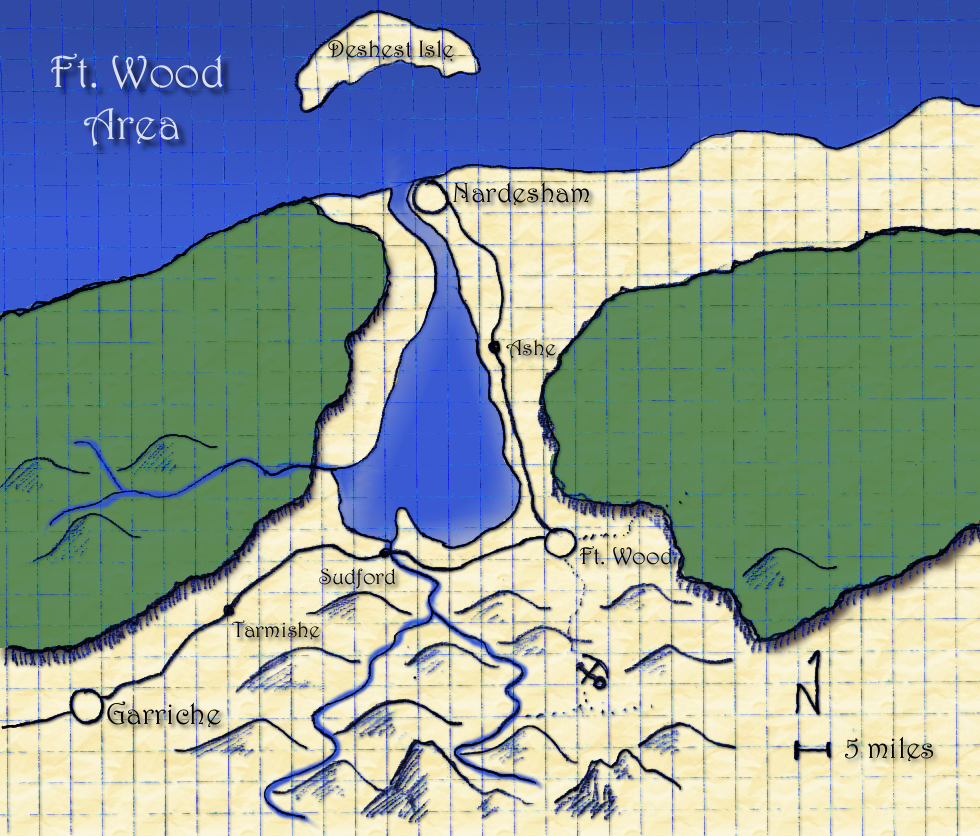 This map shows the area around Ft. Wood. There will be a series of posts related to an upcoming Unicorn Rampant release over the next few weeks. Enjoy!
Posted in Uncategorized and tagged Location by Stephen Hilderbrand with no comments yet.
Dindle Keep – Level 2
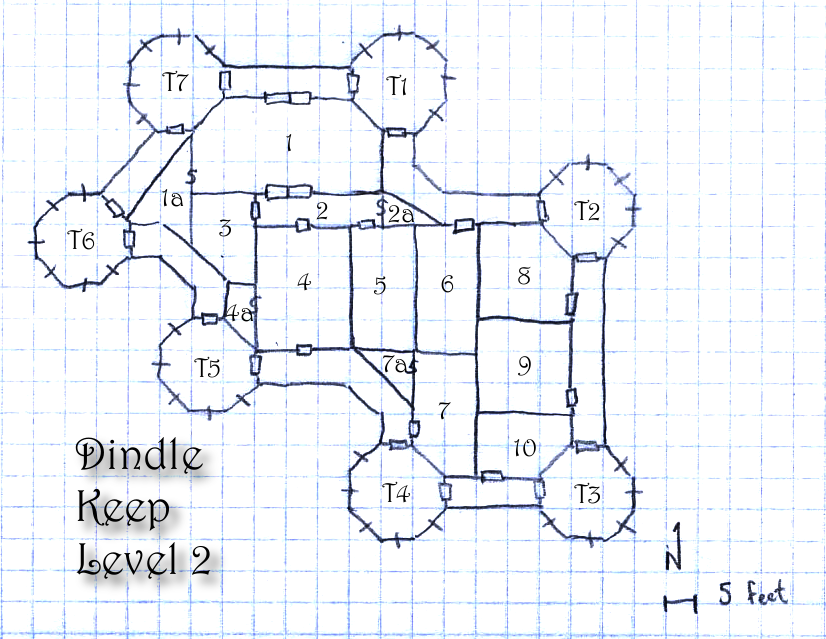 On level 2, most of the entrances to the rooms need to be approached through the hallways that line the outer walls. This means that the keep is dark on the inside, except when the torches are lit. These are found in the center of each of the hallways and hanging at the top of each stairwell. This floor is full of secrets, passageways leading to caches of items and information.
T1-T7 Towers: Each of the towers contains a small, wooden sitting chair at the top of a circular flight of stairs. The chairs face small windows through which guards keep watch on the surrounding countryside.
Hallways: The hallways between the towers are empty save torches in sconces which provide moderate light and decorative crossed swords behind wooden shields hastily painted with the logo of Dindle Keep. Spent torches are propped up against the wall. The exception is the hallway between T1 and T2, which features two guard chairs, one on each side of the door leading to 6, where the daughters are being kept under Silas’ orders, who fears that goblins will otherwise take them.
1 Master Chambers
The plushness of this room has faded with time. It appears the master has not kept up with recent trends which have swept the Jæruel, as the hardware is decades old. An unmade bed lies in the center of the room, the concave mattress showing signs of heavy use. On the floor in front of the bed is a brown bear rug. Under a colorful woven fabric, a wide armoire fills the eastern wall. An old dresser lines the southwest wall, its mirror rimmed with a black smudge.
The armoire is filled with dirty clothes. At the bottom are a leather belt with a fancy belt buckle and a pair of fur riding boots.
In the drawers of the dresser are an ornate dagger, a pouch of gold dust, and a small key. The key fits in a small, invisible keyhole in the west wall hidden by the dresser, which the party will find on a successful DC 30 search check combined with a detect invisibility spell. An 8’x5′ door opens inward once the key is placed in the keyhole and turned.
1a Secret Walk-in Closet
Chests line the walls, two deep. Hanging above the chests are ornate outfits from various events in a man’s life. Across from those are a set of outfits befitting a lady, from age eight to twenty-eight.
Creature: Babau (See MM page 40) Living here is Silas Dindle’s demon, Nadas Baran, or if you have the need to make this a more powerful encounter, substitute this demon for a marilith or other, more powerful demon. This demon will occasionally masquerade as a merchant, bringing ill news from the surrounding forests, and driving Silas into his fearful state. Nadas Baran’s minions bring plunder from surrounding lands, and this is traded for writs and other powerful pieces of paper. Nadas Baran’s ultimate goal is to lure Silas into conflict with the goblins on their terms, in their lands, or at least to convince him to send his guard out and leave the keep alone, so that he may acquire the keep.
Two of Silas’ seven guards work for Nadas Baran as do countless other merchants who operate both inside and outside the Jæruel merchant collective. Nadas Baran’s men are very loyal, and will fight on his side if he is challenged.
Silas knows nothing of this demon; Nadas Baran has been able to successfully hide from him and his men for months now, patiently running the operation of influencing Silas from the shadows.
Nadas Baran will only attack if the party has already explored much of the second floor of the keep. Otherwise, he will remain hidden until the dramatically-appropriate moment.
Treasure: various coins, gems, and jewelry totalling 2,500gp.
2 Interior Hall
This dimly-lit hall is lined with small paintings of rustic objects – a hoe, a still-life of fruit and a loaf of bread, and the portrit of a multi-generational family dressed to work the land. Sturdy-looking wooden doors lead in various directions and a man-sized mirror at the east end of the hall makes this room feel like it is larger than it is.
If the party studies the mirror in great detail, they will notice that along the frame is a latch. Flipping the latch, they are able to remove the mirror from the wall, where whoever removes it will need to make a DC 15 Balance or Strength check, due to the topheaviness of the mirror, or drop it and have it shatter. If it shatters, the various pieces attack the party as mirror shards (to follow in a future post).
In the space behind the mirror is a small archway hiding a makeshift closet.
2a Secret Hall Closet
A pile of papers fills this closet. Among them are many unsigned writs of passage and recommendations filled out in Silas’ name, as well as personal letters.
Treasure: scrolls full of information and unsigned writs. These can be sold or used to curry favor with other merchants and landowners. They would need to be signed and stamped with the Dindle seal to be made official.
The letters tell the story of Silas Dindle as a series of personal communiques. If the players read through these papers in depth, they will find out that Lady Dindle was the true keeper of the fortune, and that Silas took her surname in marriage. He once considered leaving her, but feared the wrath of her father. Then, when she took ill, he felt guilty for having considered divorce, and began to see his twin daughters as her, and thinkinghe was seeing double, began turning mad. The latest letters are written in an illegible hand.
It turns out these last letters have been written under the influence of his demon. They have, luckily, not been sent, but Nadas Baran is trying to get him to send them through legitimate channels to legitimize his claim to Dindle Keep.
3 Small Nursery
The walls are a pleasant color resembling a robin’s egg, which is slightly faded. Off to one side is one crib, and off in the room’s corner is another. The musty smell mixed with the stench of rotten eggs and the large amount of dust and cobwebs throughout the room indicates this room has not been used in years.
If the cribs are searched, down below the cobwebs which hang over them, they each contain a shiny, black egg with brown speckles. These are Babau eggs. Nadas Baran is already acting as if he owns the keep, turning this room into his nest.
4 Large Room
This room is set aside for children’s studies, with two desks facing opposite walls stacked with books.
Reading the books on local history and geography will improve the characters’ knowledge skills. If the party searches the desks closely enough, they will discover a small latch behind one of them. The latch opens a child-sized door leading to a secret cache.
4a Secret Cache
A bookcase is nestled into the corner, and a chest lies on the other end of this secret cache.
Treasure: Among the children’s books on the shelf is a minor tome of ensnarement. In the chest are various toys and dolls.
5 Long Room
This bedroom contains a bed, a chest of drawers, and a small chest serving as a footlocker at the end of the bed. A pile of rugs occupies the far end of the room.
One of the rugs contains a pack of rug rats (see future post), which rise up from the rug if anyone pulls the rug from the pile and steps upon it. The bed is normal. The chest of drawers is full of female young adult clothes.
6 Long Room
This chamber is sparsely decorated with a pair of cots, a small lantern on a wooden table. Two tomes lie open in the light.
This is where the daughters have been kept behind lock and key. They are still here, unless some other event has caused them to be moved. As the DM, use your judgment here. The books are fantasy novels that the daughters have been reading, something like Wuthering Heights but backdated to match your campaign world.
If the party is able to enter this room, they will have to have convinced Silas to let them speak with them (difficult), occupied or disabled the guards (moderate challenge), or used some form of magic or sneakery to accomplish the task (less difficult).
The daughters both know the story of what has transpired, but are unaware of much of the secret information found in 2a. They are both ready to escape the keep; living as captives in their home is unacceptable. However, because of their love for their father, they will want to help him first. Once he is freed of his demon, they will leave, Emmaigne with Lieutenant Hass and Antaigne with Captain Danus.
7 Bedroom
This bedroom contains a fine bed, a dresser, and an old rocking horse.
The bedpost farthest from the center of the room contains a small, hidden compartment, visible with a DC 30 Search check. Within the bedpost is a small scroll. Upon the scroll is a love note written in a finely-printed male hand.
The note is from the lieutenant, who is in love with one of the daughters. If pressed, he will admit this and beg the party to help him free her so they can leave this haunted place, even issue an order to the guards to let the party see the girls. He will help in the battle against the Babau if the party agrees to let the lovers leave.
The dresser contains a woman’s clothes, mostly dresses and floral tunics. The rocking horse is masterwork, built by one of the master wood workers of the Jæruel at his shop in Tannen.
7a Secret Cache
The dresser slides away, revealing a wood-paneled room. Weapons are stockpiled in this triangular room, stuffed haphazardly into the corners of the room.
Treasure:Among the weapons are a long sword +1 and a masterwork dagger. Both belong to the Dindle household.
8 Lieutenant’s Quarters
This neat room is sparsely decorated. The white sheets on the bed are clean and pressed. The keeper of this room is very organized. A lone armoire stands at the other end of the room.
Inside the armoire are two tunics and a jerkin, folded neatly. Hanging above them is a canvas uniform with multiple honors pinned upon the lapels. In the bottom of the armoire is a pair of leather sandals.
This is where Lieutenant Hass sleeps.
9 Captain of the Guard’s Quarters
The elements in this room are slightly dissheveled. Apparently the room is not regularly cared for as its 15’x15′ size deserves. The room is filled with wall-to-wall shelves, some open, some closed, some half-open, half-closed.
The open shelves reveal trophies from past battles, including chalices, small figurines, and other trinkets taken from the battlefield or potentially traded for. The closed shelves contain items considered more personal to the captain – clothing, a small, jade figurine, and various writs of passage and commendations from nobles across the Jæruel.
This is where Captain Danus sleeps. He has been troubled of late by needing to follow his liege’s orders to imprison his love, Antaigne in 6.
10 Head Archer’s Quarters
This room is decorated with a collection of feathers from various flying and non-flying avians. Used bows are hung on the wall, trophies of battles past. Leather straps and bowstrings are scattered atop the desk which serves as a workbench for a bowyer.
The head archer keeps watch not far from this room (hallway between T3 and T4), where he can see down over the south-facing cliff that faces the road below, so if the party spends much time here, he will come and watch them as they peruse his items. He also has a few uncommon items for trade if the barter is right.
Pernice is one of the more accurate archers in the Jæruel, and has worked for their organization for some time. He secretly works for the Jæruel administration in Tannen and has been stationed in Dindle Keep to keep watch on Silas. The Jæruel seeks an excuse to have him arrested so that they may take control of the keep. In this, Pernice is not evil, he is merely serving his true master. For this, he is well paid. he carries an official writ from the Jæruel which grants him the authority to make arrests in their name.
This will lead to a tense moment that the party gets to involve themselves in. Once the action reaches the climax, where Nadas Baran is exposed, Pernice will attempt to haul Silas off to Tannen, citing treacherous behavior. Of course, he has committed no crime, so this is a false accusation. The discussion will be handled in the follow-up post, The Story of Silas Dindle (part two), coming soon!
(To reiterate, the conclusion of Silas Dindle’s story is to follow in a later post!)
Posted in Uncategorized and tagged Jæruel, keep, Location by Stephen Hilderbrand with 1 comment.
Ale Break: Use of the written word
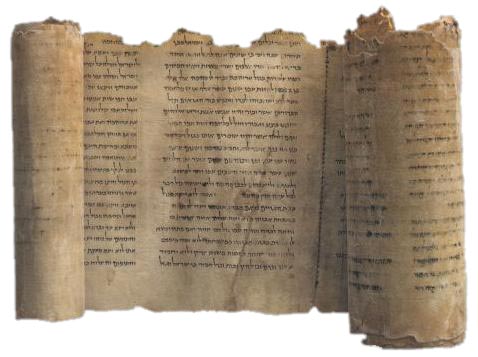 It’s nice to take a break every now and again and reflect upon running role playing games in a way that adds drama and excitement to the experience.
The written word doesn’t tend to take place so much in fantasy worlds, partly due to the historical precedent of illiteracy in Medieval European societies. However, most player characters end up interacting with the upper classes and powermongers of the societies they roll in, so at some point, they will likely encounter the written word.
This can provide a fun game element, especially if many of the characters do not read the official written language. Present your characters with a riddle, cryptogram or a set of hieroglyphs and watch the players try to solve the puzzle. This will likely lead to various competing interpretations, which, if your players are really role playing, will play out in their interactions. A cleric may consider it a message from a god and consider it his word and thus up to him to interpret. A rogue may see it as a coded message leading to a treasure. A fighter may see it as a document of surrender. An elf may find it primitive dribble. Hopefully your players will find a more nuanced position, assuming you present the right symbols.
For sources, check out books in the library or have a look online in old books for something that looks right. Or make one up yourself. It’s easy to sit down and write something up. For instance, in a recent session, I presented my characters with a sheet that was nailed to the door of an abandoned keep. What was written wasn’t as important as that fact that it was written in three distinct languages. So I made up some characters and used them in ways that looked like a fancy, almost magical script, a character-based language, and a hieroglyphics-inspired pictoral representation.
In addition, consider using writs of passage and official documents that travel the land, as well as secret messages sent out during the night. These present opportunities for characters to be sent on missions as couriers, and end up starting or preventing a war upon delivery, involving them very directly in the overarching story of the campaign and thus have the players feel agency in the game itself. These scenarios also allow the party to discuss the ethics of opening mail before it arrives at its intended destination, etc. Some may find this despicable, others may consider it the only way to ensure that the right things is done. Still others may be dastardly rogues who just want to meddle in other people’s affairs. All of these are welcome (nay, encouraged) in fantasy role playing games!
This drama is harder to sustain and play out with the common use of message, sending and other spells. Limit the use of these spells in your campaign if you want the written word to have any use. I recommend it; in my opinion, convenience kills role playing. It is urgency that propels storylines, not convenience.
The same is true for the use of multiple spoken languages. One way to spice up your game is to give NPCs who do not speak so-called “common,” or perhaps speak a different common than the PCs, strange accents and broken use of the language. Imagine a Frenchman or German speaking English. Even when they do speak it well, there are regular pronunciation artifacts that tag someone as having a “French or German accent.” This can be a great way of linking an NPC that the party knows nothing about with a specific region, based entirely on accent, no in-game “Where are you from?” “I hail from the Kingdon of Blah” dialogue, which can be cumbersome, and not necessarily realistic. Why would this person who doesn’t know you tell you where he’s from or even more fundamental, why would this NPC parley with the party in the first place? But if the characters overhear him gloating about killing a giant, they learn much about where he’s from and what’s been doing.
Of course, spells like tongues can completely negate the use of different languages in your game. This is why it may make sense to remove these spells entirely from the game, or have them only be able to be learned after a considerable amount of work or a quest.
Questing for spells is another way to add texture to your campaign. More on that in a later post.
Posted in Editorial and tagged ale break, language by Stephen Hilderbrand with no comments yet.
Dogs of War
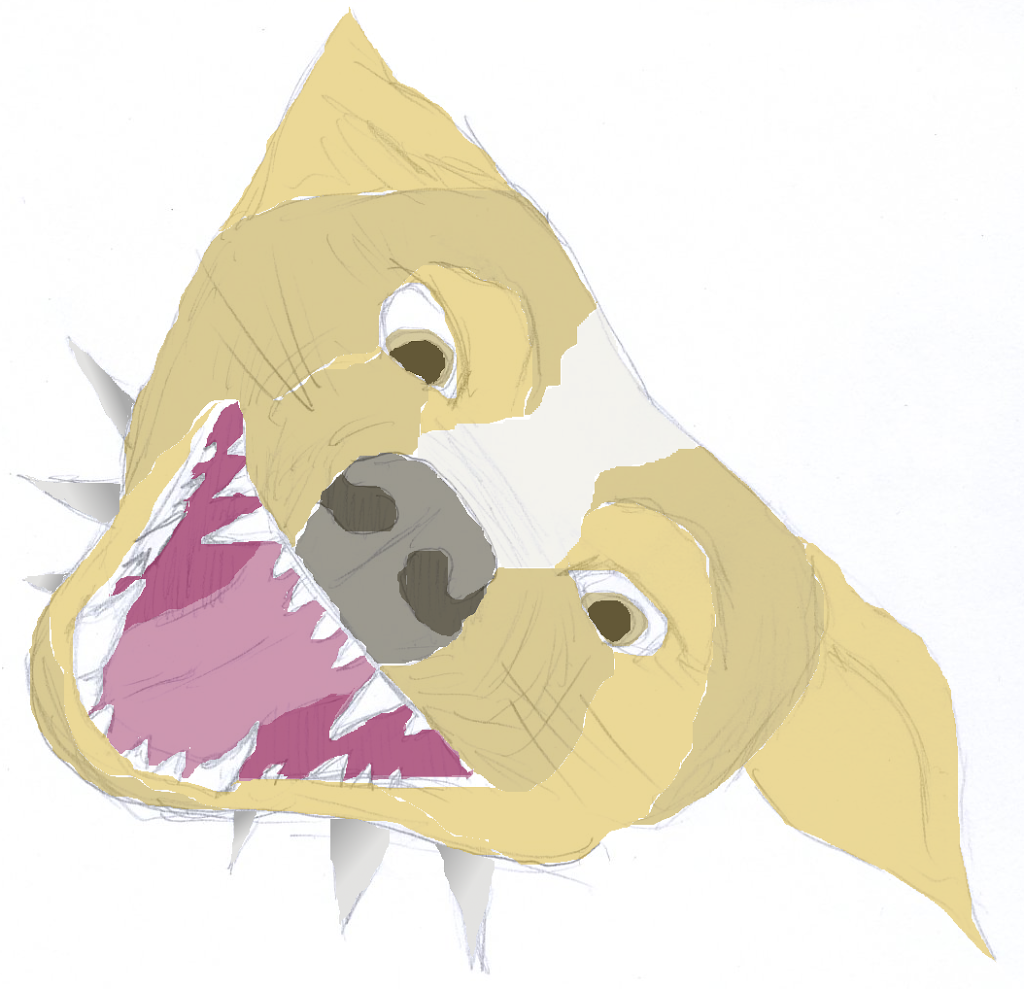 Dogs of war and men of hate
With no cause, we don’t discriminate
Discovery is to be disowned
Our currency is flesh and bone
— the bard band Floidus Pinkus
Dogs of War
Size/Type: Medium Outsider (Neutral, Extraplanar, Lawful)
Hit Dice: 8d8+16 (52 hp)
Initiative: +7
Speed: 50 ft. (10 squares)
Armor Class: 22 (+3 Dex, +6 natural, +3 hide armor), touch 13, flat-footed 16
Base Attack/Grapple: +8/+16
Attack: Bite +13 melee (1d8+3/19-20 plus 1d6 electricity)
Full Attack: Bite +13 melee (1d8+3/19-20 plus 1d6 electricity)
Space/Reach: 5 ft./5 ft.
Special Attacks: Breath weapon, electric bite
Special Qualities: Darkvision 60 ft., immunity to electricity, scent, vulnerability to water
Saves: Fort +9, Ref +9, Will +6
Abilities: Str 20, Dex 17, Con 15, Int 8, Wis 11, Cha 4
Skills: Intimidate +15, Jump +16, Listen +12, Spot +15, Survival +8*, Tumble +7
Feats: Alertness, Improved Critical (bite), Improved Initiative, Weapon Focus (bite)
Environment: Lawful plains, battlefields
Organization: Pack (5-12)
Challenge Rating: 6
Treasure: None
Alignment: Always lawful neutral
Advancement: 9-12 HD (Large); 13-16 HD (Huge)
Level Adjustment: +3 (cohort)
A typical dog of war stands 5½ feet high at the shoulder and weighs 160 pounds.
Dogs of War are never encountered alone. They travel only in packs, and are often conscripted to fight both sides of large battles. They do not speak but communicate through a series of barks, yelps, and growls and can be taught battle commands.
Combat
Dogs of war are trained to fight as tight packs, using their strong initiative and skill with their razor-sharp teeth to swarm and flank their opponents. They are also often used as artillery, breathing bolts of lightning into melee.
The natural weapons of dogs of war are treated as neutral-aligned and lawful-aligned for the purpose of overcoming damage reduction.
Breath Weapon (Su): 10-foot-long bolt that travels up to 100 feet, once every 3 rounds, damage 2d6 electricity, Reflex DC 17 half. The save DC is Constitution-based.
Electric Bite (Su): Dogs of war deal an extra 1d6 points of electric damage every time they bite an opponent, as if these bites are electric weapon.
Skills
Dogs of war have a +5 racial bonus on Hide and Move Silently checks, though these are rarely used, except in surprise raids.
*They also receive a +8 racial bonus on Survival checks when tracking by scent, due to their keen sense of smell.
Posted in Creature and tagged dog, electric subtype, extraplanar subtype, outsider, proppian by Stephen Hilderbrand with no comments yet.
Omnibus 1 Released!
 The first fifteen issues of Claw/Claw/Bite for the price of five!
Welcome to our world of strange and wonderful things, traveler. Bizarre treasures, cunning adversaries, powerful adventurers, and mystic realms are waiting for you. This omnibus is a collection of some of our best work over the past two and a half years.
It’s been a great joy to bring this material to you for the past few years, and we have every intent to continue this magazine, even as our new periodical, Tailslap, is gaining in popularity alongside the new edition of the core rules.
Our goal is to be a one-stop shop for you, the storyteller. All of our creations are designed for d20 3.5 rules. Many of the game elements that you see in this periodical will find their way into modules published by Unicorn Rampant, which will be available on RPGnow.com!
Go pick up your copy at rpgnow.com
Posted in news and tagged release by Stephen Hilderbrand with no comments yet.
Silverhorn
 first you wanna kill me, then you wanna kiss me… blow!
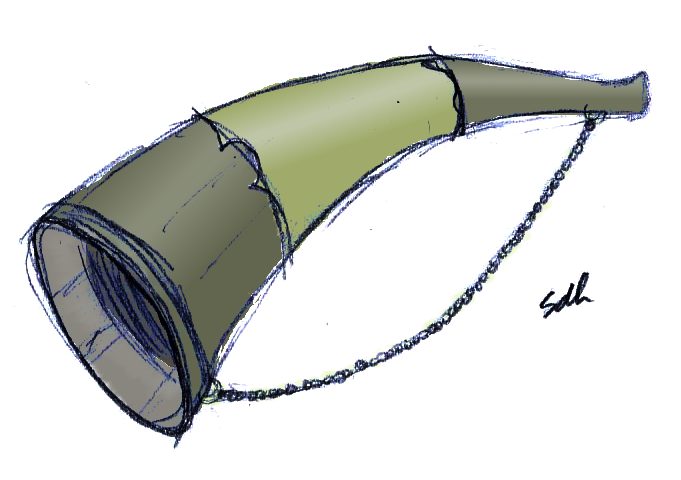
The Silverhorn is an instrument famous for its powers of aiding negotiation. When blown, the horn emits an enchantment that encourages compromise. Those within earshot (including the blower) must make a DC 25 Will save or end up under the enchantment that finds middle ground between a buyer and a seller, or between multiple parties in a political negotiation.
A strategy employed by previous owners of the Silverhorn is to ask a ridiculous price for an item up for sale, then blow the horn, waiting for the best offer to come in. Of course, the Silverhorn does not guarantee that the average of the prices be affordable to the buyer, nor does it necessarily compel them to make a purchase.
The Silverhorn itself is tarnished from years of use, but is just as potent as when it was wrought a hundred years ago by a dwarf high in the mountains, one who participated in the conquest of a dragon. This is how he spent his horde, in the hopes of taking the other dwarves’ shares slowly, one financial transaction at a time. Whether or not he was successful is lost to the winds like so many story endings.
Posted in Uncategorized and tagged instrument, minor artifact by Stephen Hilderbrand with no comments yet.
Dindle Keep – Level 1
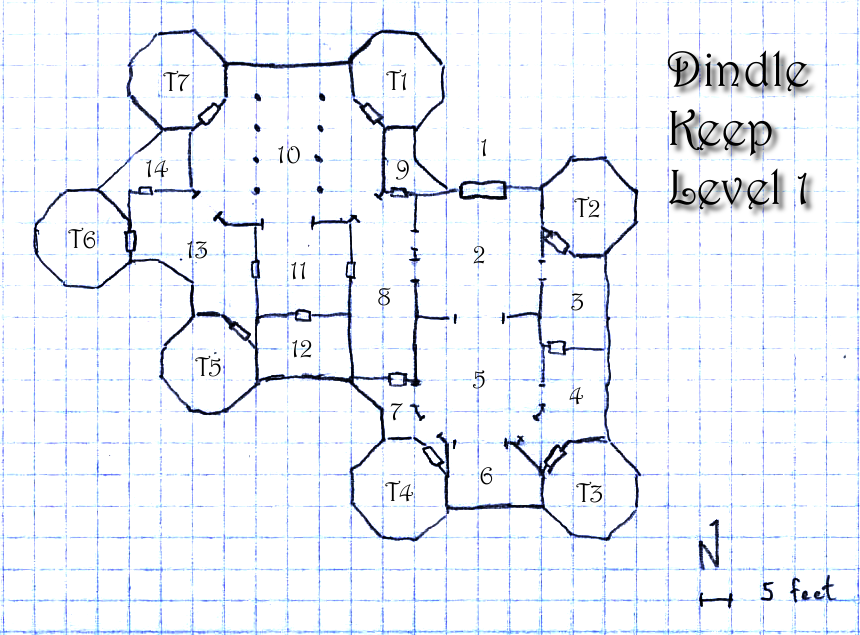 The party will arrive from the trail to the south, having had the guards in the toll houses far below signal up that they en route on business. This trail wraps around the front of the keep, which is inaccessible from the side facing the road.
Note of course that if the party is caught stealing anything or is deemed dangerous and unfriendly by Silas, the guards will attack the party, taking custody of them, and preparing them for delivery to Jæruel headquarters in Tannen.
If the party decides to sneak into the keep at night, Silas will be sleeping up in his room, his daughters both awake and sending messages to one another through a series of taps on the walls. Guards will be posted in many of the towers, in the entry hall, and outside their three rooms, two for Silas, and one for each of his daughters.
Towers – each of the hexagonal towers contains a small bed a the bottom of a staircase leading up. There is no level to the keep below ground; the bedrock was too hard to easily build into when the keep was built over a hundred years ago.
1 Outside the Keep
The tall door leading into the keep is nestled in between two towers on the uphill side of the keep. Tight clusters of cypress line the walls in patches along a neatly-fitted brick and stone walkway. The tall door is emblazoned with the emblem of the profile of a woman’s head and shoulders on a deep yellow shield. A man in impressive field plate with the same emblem upon it steps forward, says “Ho!” and waits for the party to bow.
Once they do, he steps forward, introducing himself as Lanx and holding his arm out, pointing the way to the door.
2 Entrance Hall
As the party approaches, read the following:
The oversized door creaks on its hinges as it opens, leading into the keep from the uphill side. A man who introduces himself as Lanx bids the party, “Welcome to Dindle Keep. Keep your troubles outside!” As everyone steps through the door, two armed guards wield the heavy portal and latch it shut with a large caber. They turn to watch the party.
3 Study
This moderately-sized room is lined with short bookshelves. Atop the shelves are various houseplants taken from the fields and forests in the local region. Upon the walls are landscape oil and watercolor paintings of sunrises and sunsets in brilliant hues. A lone candelabra illuminates a table in the center of the room. A book lies open in the central reading chair.
The book is on the local folklore, containing small, hand-drawn maps from storytellers. There are annotations pencilled into the margins, and the names of places underlined.
In the early evenings, Silas retires to the study to improve his knowledge of history, geography, and religion. He will be found here if visited in the evening.
4 Library
An impressive collection of books lines the walls of this room, the leather spines like the scales of a dragon. In the center of the room is a large table upon which rest a collection of maps.
If thoroughly searched, the party will find books on the local geography and history, which if studied, raise those skills by a point each.
5 Statuarium
Worn, humanoid statues occupy the two hard corners of the room, with the far walls coming together at 45 degree angles toward the rest of the keep. The stone ceiling rises another two feet above the floor to accommodate the tall statues.
The two statues have the emblem of the Dindle family etched in them. A careful inspection of the statues reveals small sets of wings on both of them, jutting out just past the shields slung over their backs. This hints at a relationship with the celestial.
6 Back Chamber
Passing under another large arch, the wooden ceiling lowers to a more normal height. A stone fireplace occupies the center of the exterior wall, with a gold leaf framed, life-sized oil rendition of a middle-aged man eerily staring out across the keep back toward the entrance.
7 Small Hall
Between two arches, modest paintings of former denizens of the keep find refuge in a dark corridor with wooden doors at either end.
Artistic renditions of multiple generations are represented in the frames. In a hidden alcove behind one of the paintings of the twin girls is a key ring with extra keys to each of their rooms (on Level 2).
8 Wide Hallway
Paintings of old relatives line this wide hallway, including as the most illuminated one, labeled “Lady Dindle.” Doors are set in opposite ends of the hall, and one is also set in the center of the hall. Three archways keep the hall fairly open-feeling, like the rest of the keep.
If the painting is studied in any detail, read the following:
Lady Dindle was an beautiful, yet austere woman. These traits come out in her appearance, with a scornful scowl scratching the surface of her glowing skin.
9 Closet
This moderately-sized closet is adorned with wood-paneled walls. Jacket, coats, mittens, hats, two sleds, tack, and other sundries are hung here on various metal hooks that jut from the walls.
Treasure: In the pocket of one of the jackets is a pair of gloves of storing.
10 Throne Room
Eight alabaster columns line the fine carpet leading up to a pair of sitting chairs etched with the Dindle arms.
If it is daytime, and there are guests in the keep, Silas will be here, providing them an audience. If Silas is here, he will be flanked by two guards armed with swords at their sides. Merchants pass through, bringing stories, which Silas is eager to hear. He has been known to reduce the toll on the road for those who provide him with quality entertainment. (more in a later post)
Treasure: A masterwork instrument called the Silverhorn hangs to the right side of the throne.
11 Dining Room
A large table is set in the center of the room, requiring everyone to walk along the walls to navigate the space. A large brass candelabra rests upon the table, illuminating the room in a warm glow. Along the floor, paralleling the impressive table, is a finely-woven rug.
Treasure: The rug is worth 1500gp, the candelabra 500gp.
12 Den
Small tables and chairs are tastefully laid out in the room facing each other, with a simple rug in the center.
Treasure: There are a few loose coins in the seat of the chairs.
13 Kitchen
Years of caked on grease and other food cling to the walls, leaving them black toward the ceiling, where a tapered ceiling has led thousands of plumes of smoke out of the keep. A large oven and multiple stoves line the exterior brick walls of this room. Pots and pans hang suspended from the ceiling in the center of the room.
Various foodstuffs can be found throughout the kitchen.
14 Pantry
This oddly-shaped, dusty room is full of large crates, barrels, and bags of flour and wheat. Tiny flour footprints lead in all directions.
Creature: There are 3 large rats in this room.
Treasure: A potion of charm person lies at the bottom of a crate otherwise full of hay.
Posted in Uncategorized and tagged Jæruel, keep, Location by Stephen Hilderbrand with no comments yet.
Unicorn Rampant is going to Owl Con!

We are proud to announce that we’ll be attending our first ever convention as a vendor this Feburary 6-9th at OwlCon, at Rice University in Houston Texas!
We’ll bring along some of our wares to peruse in printed form, and if you mention seeing this announcement on our blog, we’ll give you half off on all of our products! We’ll also be set up to give you discounts on any of our products you’d like to buy from RPGnow.com.
And of course, we’ll be set up to play some games right there at our table, so come on down and say hi!
Posted in convention, news by Adam A. Thompson with no comments yet.